Echo Frames: Conversational Voice AI (VUI)
A contract inside Amazon’s device innovation lab designing the companion mobile experience for Echo Frames, the screenless, voice-first smart glasses built around an ambient-computing vision: Alexa available all day with nothing to look at and nothing to hold. I worked alongside the AWS and Alexa teams in Sunnyvale.
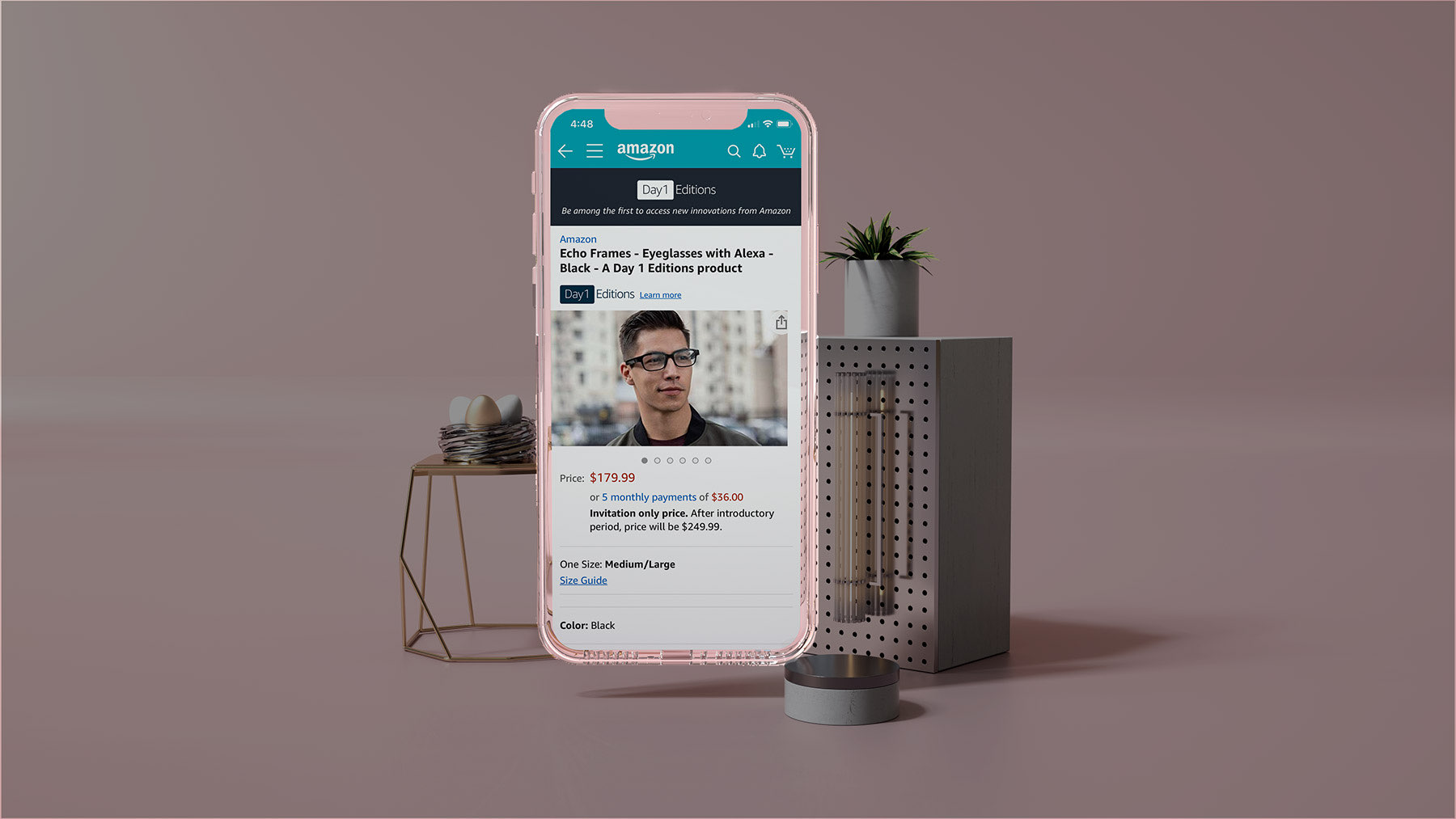
Lab126’s brief was a north star: ambient computing you wear, with Alexa available throughout your day and no screen to look at, no phone to hold. The hardware made that radical. Unlike Google Glass there was no camera and no display, just open-ear audio in a 1.1-ounce pair of glasses that had to pass as ordinary eyewear, built inside a program secret enough that testers walked city streets shielding each other from view. All of that pushed unusual weight onto the companion app: with no screen on the device itself, the phone carried the entire setup, Bluetooth pairing, settings and the whole mental model of what these glasses even were. The design had to make an unfamiliar, screenless product feel obvious from the very first interaction.
I designed the companion mobile experience for Echo Frames: comps, visual layouts and rapid prototypes for first-run setup, Bluetooth pairing and the settings that tune a device with no screen of its own. The goal was to translate an ambient, voice-first vision into something a new owner could learn on their phone in minutes and then forget about, the same disappear-into-the-background principle the hardware team was chasing. I worked alongside the AWS and Alexa teams inside Lab126 in Sunnyvale, designing against a product that would not reach Amazon’s experimental Day One Editions program until September 2019, roughly two years after this early companion work.
A prototyped companion app that framed the smart-glasses experience and gave the hardware team a tangible interaction model to test against. The companion-app pattern shipped into the broader voice-first Amazon ecosystem that scaled from roughly 100 million Alexa-enabled devices in 2019 to more than 600 million by 2025, with the Echo family now in about 61% of U.S. homes and holding an 84% share of the U.S. smart-speaker market.
- 100M → 600M+
- Alexa-enabled devices sold worldwide · 2019 to 2025 · the voice-first ecosystem the companion UX serves
- 84% share
- Alexa's share of the US smart-speaker market · Echo leads every rival
- 61% of US homes
- own an Amazon Echo by end of 2024 · mass adoption of the device family